
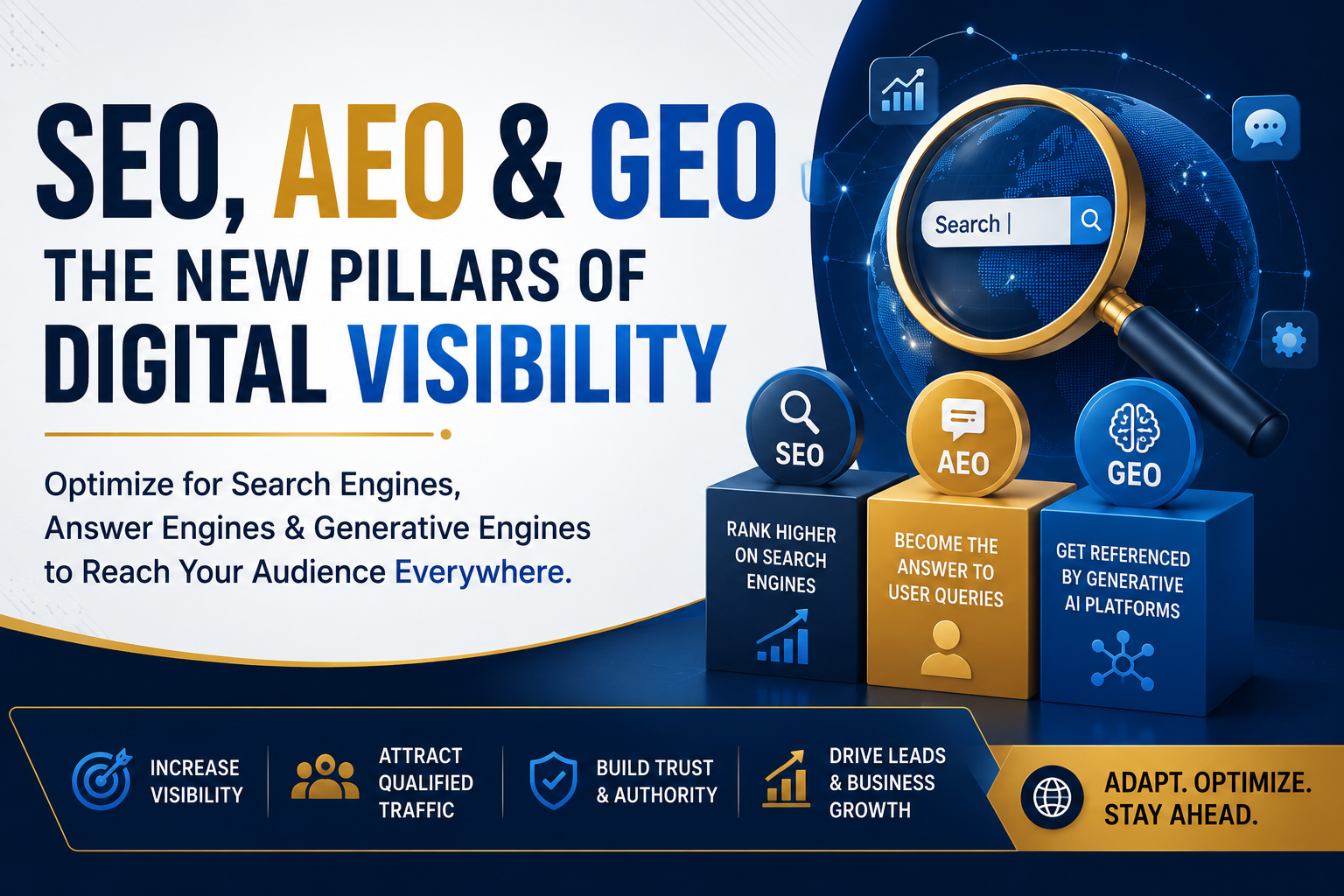
SEO, AEO, and GEO: The Complete Guide to Winning Visibility in the Age of AI Search
Introduction
The digital search landscape is undergoing its biggest transformation since the introduction of search engines. For more than two decades, businesses focused primarily on Search Engine Optimization (SEO) to improve rankings on platforms like Google and Bing. The objective was straightforward: optimize web pages with relevant keywords, build authoritative backlinks, and create valuable content to drive organic traffic.
Today, however, search behavior is changing rapidly.
Users are increasingly turning to AI-powered search experiences and conversational assistants to find information, compare products, and make purchasing decisions. Instead of scrolling through a list of blue links, they expect direct, personalized, and context-aware answers. This shift has introduced two new optimization strategies: Answer Engine Optimization (AEO) and Generative Engine Optimization (GEO).
SEO, AEO, and GEO are not competing approaches—they are complementary strategies that help businesses remain visible across traditional search engines, AI assistants, and generative search platforms. Organizations that understand and implement all three will be better positioned to attract qualified traffic, build authority, and generate high-quality leads in the evolving digital ecosystem.
This article explores the differences between SEO, AEO, and GEO, why each matters, and how businesses can create a future-ready content strategy.
Understanding SEO (Search Engine Optimization)
Search Engine Optimization (SEO) is the practice of improving a website’s visibility in traditional search engine results pages (SERPs). The goal is to attract organic traffic by ensuring that webpages rank highly for relevant search queries.
SEO involves optimizing content, website structure, technical performance, and authority signals so that search engines can easily understand and index your pages.
Core Components of SEO
Effective SEO includes:
- Keyword research
- On-page optimization
- Technical SEO
- Mobile optimization
- Site speed improvements
- Internal linking
- Structured data
- High-quality backlinks
- Content marketing
- User experience optimization
SEO remains the foundation of long-term digital marketing because it helps businesses attract users actively searching for information, products, or services.
Benefits of SEO
Organizations investing in SEO often experience:
- Increased organic traffic
- Better brand visibility
- Higher search rankings
- Improved website credibility
- Lower customer acquisition costs
- Sustainable lead generation
- Higher return on marketing investment
While SEO requires consistent effort, it delivers long-term value by generating traffic without relying solely on paid advertising.
What Is AEO (Answer Engine Optimization)?
Answer Engine Optimization (AEO) focuses on optimizing content so that search engines and AI-powered assistants can provide direct answers to user questions.
Instead of optimizing only for rankings, AEO aims to become the source of the answer itself.
Examples of answer engines include:
- AI chat assistants
- Voice assistants
- Smart speakers
- AI-powered search summaries
- Featured snippets
- Knowledge panels
When users ask:
“What is zero-trust security?”
An answer engine attempts to deliver a concise, accurate response immediately.
Businesses that optimize for AEO increase their chances of being selected as the trusted source behind these answers.
Why AEO Matters
Modern users increasingly prefer quick, conversational answers rather than browsing multiple webpages.
AEO helps businesses:
- Build authority
- Increase brand recognition
- Capture zero-click search opportunities
- Improve voice search visibility
- Reach mobile users
- Support conversational search experiences
As AI assistants become more widely adopted, AEO will play a larger role in digital visibility.
Best Practices for AEO
To optimize for answer engines:
Write Clear Answers
Answer common customer questions directly and concisely before expanding into detailed explanations.
Use Structured Headings
Organize content using descriptive headings such as:
- What is…
- Why is…
- How does…
- Benefits of…
- Best practices…
This helps AI systems understand page structure.
Implement Structured Data
Schema markup improves machine readability by identifying:
- FAQs
- Articles
- Products
- Organizations
- Reviews
- Events
Create FAQ Sections
Frequently Asked Questions naturally align with conversational search behavior.
Focus on Expertise
Answer engines prioritize reliable, accurate, and trustworthy content.
What Is GEO (Generative Engine Optimization)?
Generative Engine Optimization (GEO) is the practice of optimizing digital content so that generative AI systems can understand, reference, summarize, and recommend it when generating responses.
Unlike traditional search engines that rank webpages, generative engines synthesize information from multiple trusted sources to create conversational answers.
Examples of generative search experiences include:
- AI-powered search assistants
- Conversational search interfaces
- Enterprise AI knowledge assistants
- Large Language Model (LLM)-based search platforms
Instead of asking users to visit multiple websites, these systems provide summarized responses while citing or referencing authoritative sources.
GEO focuses on ensuring your content is accurate, comprehensive, well-structured, and authoritative enough to become part of those AI-generated answers.
Why GEO Is Becoming Essential
Generative AI is fundamentally changing how people discover information.
Rather than typing:
“Best CRM software”
Users increasingly ask:
“Which CRM platform is best for a growing B2B SaaS company with remote sales teams?”
Generative engines analyze intent, context, and user preferences before producing detailed recommendations.
Businesses that optimize for GEO improve their chances of being included in these AI-generated responses.
GEO Optimization Strategies
Publish High-Quality Content
AI systems prioritize:
- Comprehensive guides
- Original research
- Expert insights
- Industry analysis
- Data-driven content
Thin or repetitive content is less likely to be referenced.
Demonstrate Experience and Expertise
Content should clearly reflect subject matter expertise by including:
- Real-world examples
- Practical recommendations
- Case studies
- Research findings
- Industry best practices
Keep Content Updated
AI systems favor accurate and current information.
Regularly review and refresh:
- Statistics
- Trends
- Regulations
- Product information
- Industry developments
Build Brand Authority
Generative engines often recognize brands that consistently publish trustworthy content across multiple channels.
Authority is strengthened through:
- High-quality backlinks
- Industry recognition
- Thought leadership
- Expert interviews
- Original research
Improve Content Structure
Well-organized content helps AI models better understand relationships between concepts.
Use:
- Headings
- Bullet points
- Tables
- Definitions
- Summaries
- Step-by-step explanations
SEO vs AEO vs GEO
| Feature | SEO | AEO | GEO |
|---|---|---|---|
| Primary Goal | Rank webpages | Become the direct answer | Be referenced by AI-generated responses |
| Audience | Search engine users | Voice and answer engine users | Conversational AI users |
| Focus | Keywords and rankings | Questions and concise answers | Comprehensive, authoritative content |
| Success Metric | Organic traffic | Featured answers and snippets | AI citations, mentions, and brand visibility |
| Content Style | Optimized webpages | FAQ and answer-focused | In-depth, contextual resources |
| User Intent | Search queries | Specific questions | Conversational exploration |
Why Businesses Need All Three
Many organizations mistakenly believe GEO will replace SEO.
In reality, the future belongs to businesses integrating all three strategies.
SEO ensures discoverability in traditional search.
AEO improves visibility in answer engines.
GEO increases recognition within AI-generated responses.
Together they create a comprehensive digital visibility strategy.
Creating Content for SEO, AEO, and GEO Simultaneously
A single piece of content can support all three optimization strategies.
For example, a blog on Cloud Security might include:
SEO
- Keyword optimization
- Internal links
- Optimized metadata
- Technical performance
AEO
- FAQ section
- Direct definitions
- Concise summaries
- Structured headings
GEO
- Industry research
- Expert commentary
- Practical frameworks
- Case studies
- Actionable recommendations
This integrated approach maximizes content value across multiple discovery channels.
The Role of AI in Modern Search
Artificial intelligence now influences nearly every stage of search.
AI assists with:
- Understanding user intent
- Semantic search
- Personalized recommendations
- Content summarization
- Conversational interfaces
- Predictive search
- Knowledge synthesis
Businesses must therefore optimize not only for search engines but also for AI systems that interpret, summarize, and recommend content.
Common Mistakes to Avoid
Organizations adapting to AI search should avoid:
- Publishing thin, low-value content.
- Overusing keywords.
- Ignoring structured data.
- Creating duplicate articles.
- Neglecting content updates.
- Failing to answer user questions clearly.
- Overlooking mobile experience.
- Ignoring technical SEO.
- Publishing AI-generated content without human review.
- Forgetting to measure performance across multiple search experiences.
Measuring Success
Success metrics vary depending on the optimization strategy.
SEO Metrics
- Organic traffic
- Keyword rankings
- Click-through rate (CTR)
- Backlink growth
- Domain authority
AEO Metrics
- Featured snippet visibility
- Voice search performance
- FAQ engagement
- Zero-click search impressions
GEO Metrics
- AI-generated citations
- Brand mentions in AI responses
- Referral traffic from AI search experiences
- Engagement with long-form educational content
- Growth in branded searches
Tracking a combination of these metrics provides a more complete view of digital visibility.
The Future of Search Optimization
The future of search is likely to become increasingly conversational, personalized, and AI-driven.
Emerging trends include:
- AI-powered search assistants becoming primary discovery tools.
- Greater emphasis on first-party expertise and trustworthy sources.
- Multimodal search combining text, voice, images, and video.
- Personalized AI recommendations based on user context.
- Greater use of structured data and semantic content.
- Real-time content updates influencing AI-generated responses.
Businesses that adapt early will have a significant competitive advantage.
Best Practices for Future-Proof Content
To succeed across SEO, AEO, and GEO:
- Prioritize user intent over keyword density.
- Publish original, research-backed content.
- Use clear headings and logical page structures.
- Add FAQ sections and concise summaries.
- Keep articles current and factually accurate.
- Optimize website speed and mobile usability.
- Implement structured data where appropriate.
- Build authority through consistent thought leadership.
- Create content that solves real business problems.
- Continuously analyze performance and refine your strategy.
Conclusion
The evolution of search is creating exciting opportunities for businesses willing to adapt. While Search Engine Optimization (SEO) remains essential for improving visibility in traditional search engines, Answer Engine Optimization (AEO) helps brands become trusted sources for direct answers, and Generative Engine Optimization (GEO) positions content to be referenced by AI-powered search experiences.
Rather than choosing one approach over another, forward-thinking organizations should embrace all three. By combining technical SEO, answer-focused content, and authoritative, comprehensive resources, businesses can ensure they remain discoverable wherever their audience searches—whether through search engines, voice assistants, or conversational AI platforms.
As AI continues to reshape digital discovery, success will belong to organizations that prioritize quality, expertise, and user value. Creating content that informs, answers, and earns trust will not only improve visibility but also build stronger relationships with customers in the new era of intelligent search.
Comments are closed.